![Autonomous Claude Code Agent: 8 Layers That Stay Safe [2026]](/_next/image?url=%2Fblog%2Fautonomous-claude-code-agent-hero.webp&w=3840&q=75)
An autonomous Claude Code agent sounds like the dream: you give it a plan, you go to sleep, you wake up to finished work. The reality, the first time you try it, is usually a branch full of confident garbage. The agent wrote code, wrote its own test, judged its own test, declared victory, and moved on. At interactive speed you catch that. Overnight, across a queue of tasks, you do not.
So this is the part nobody shows. Not the loop, the loop is easy. The hard part of an autonomous Claude Code agent is the layer that makes unattended action safe to trust: a system that can act on everything reversible by itself, prove each action against real state before it counts as done, and surface only the decisions that genuinely need you. I run this as a single command. Below is its full anatomy, in eight layers, with reference code you can build from.
An autonomous Claude Code agent is only as safe as the layers around its loop. Eight of them matter: a human trigger, a decide-and-execute contract, a single-session lease, a quota governor, reversible-only worktrees, a forced verification gate, a safety spine it cannot self-edit, and a verify-before-change check. The loop is 5% of the work. These layers are the other 95%.
Why most autonomous agents are confidently wrong
An autonomous Claude Code agent fails in a specific way: it convinces itself that broken work is done. The agent that writes a change also writes the test for it, so the test encodes the same blind spots as the bug. It runs green. It commits. The closeout says "shipped." Then you use the feature and nothing happens, because a passing test is evidence of an action, not evidence of an outcome.
This gets worse with autonomy, not better. The more steps the agent runs without you watching each one, the more unverified "done" claims stack on top of each other. I wrote about the core of this in Claude Code verification: evidence that an action happened is not evidence that the outcome happened. An autonomous agent is a machine for generating action evidence at scale, so it needs an outcome check wired into every iteration, or it ships fast and wrong.
- -while work_left: do_next()
- -Grades its own output
- -No budget awareness
- -Hard-deletes and overwrites
- -Can edit its own guardrails
- +Human-triggered, never self-spawns
- +Separate adversarial verifier
- +Refuses below a budget floor
- +Reversible-only, worktree-isolated
- +Safety spine is off-limits to itself
What makes an agent actually autonomous?
Autonomous means decide, execute, and keep going until there is genuinely nothing safe left to do. A run that drains one task and then stops to ask "want me to commit, or build the next thing?" is not autonomous, it is a slow assistant. The first version of mine did exactly that, and fixing it was a mindset change, not a code change.
The fix is a loop contract with four rules:
- Never end with a question or an option menu. The agent has full authority over reversible work. The only things that surface are hard stops, and even those are a flagged statement, not a menu.
- Decide-and-execute defaults. Reversible work gets committed to the session branch after each batch. An excluded or unsafe item gets skipped and logged. An item that needs a real design decision, or is over roughly thirty minutes, or is destructive without a backup, gets deferred with a reason code and logged. None of these becomes a question.
- Loop until dry. After each batch, re-read the work signal. If it still fires, drain again. Stop only when the queue is empty, the budget governor refuses, the verifier hits a kill criterion, or every remaining item is excluded or deferred.
- Closeout is a report, never a question. State what was committed, what was deferred with reason codes, what was skipped.
def autonomous_loop(ctx):
    while True:
        signal = compute_signal(ctx.repo_root)       # is there work?
        if not signal.fires:
            break                                     # queue dry
        if check_governor(ctx.repo_root) == "REFUSE":
            break                                     # out of budget
        for item in drain_batch(signal):
            decision = decide(item)                   # act / skip / defer
            if decision == "act":
                apply_in_worktree(item)               # reversible
                if stop_gate(item).passed:            # verified
                    commit(item)                      # default, never ask
                else:
                    discard_worktree(item)
            elif decision == "defer":
                log_deferred(item, reason_code)
        # loop back, re-read the signal
    return write_report()                             # never a question
That single loop only works because of the layers wrapped around it. Each one can stop the flow, and that is the point.
The 8 layers at a glance
The eight layers form a chain of gates. The trigger bounds the blast radius, the lease and governor decide whether to run, the work signal decides if there is anything to do, verify-before-change and the spine guard decide what is safe to touch, the worktree makes every attempt undoable, and the verification gate decides what counts as done.
Layers 1 and 2 I covered above. Here is the rest, with the exact logic.
How does the agent decide what is safe to do alone?
The agent decides per item, with three outcomes: act, skip, or defer. Anything reversible and within scope gets acted on and committed. Anything excluded by policy gets skipped and logged. Anything that needs judgment gets deferred with a reason code. The skill is in which decisions to escalate, not in escalating none or all of them.
Before deciding, the agent runs a lightweight reasoning pass per item: decompose the item into its concrete claim, suspend on the alternative reading it has not considered, then validate the claim it is least sure of first. If that surfaces a broken assumption, the item defers instead of proceeding. This is the same discipline I use when planning complex work, shrunk to three questions per item so it costs almost nothing.
A deferred item is not a failure, it is the agent being correct about its own limits. The closeout lists every deferral with a reason code so nothing rots silently. "I did not do these and here is exactly why" is worth more than a branch of confident, unchecked commits.
The lease and the governor
Two autonomous sessions running at once will read-modify-write the same state files and silently corrupt each other, so the agent claims a single-session lease before it does anything. A second activation in another session is refused. A lease older than four hours is treated as stale and can be reclaimed, because the original session probably died.
LEASE_TTL_SECONDS = 4 * 3600

def claim_lease(session_id, lease_path):
    with locked(lease_path) as f:                     # flock, never a bare mv
        cur = read_state(f)
        if cur.session_id == session_id and not cur.released:
            return cur                                # idempotent re-claim
        if cur.session_id and not cur.released and not cur.is_stale():
            raise LeaseRefused(f"held by {cur.session_id}")
        return write_state(f, session_id)             # claim it
The governor is the second gate: before each run, and again between work items, it checks how much model budget is left and decides whether to proceed. This protects your interactive budget so the agent yields the moment headroom gets tight.
The boundary at exactly 20% falls to throttle, not refuse. When no budget data is available at all, the agent assumes a conservative default rather than blindly running. It is the same instinct behind tmux orchestration for parallel sessions: the constraint that actually bites is not tokens, it is not stepping on yourself.
Reversible-only and the worktree
The reason you can let this run while you sleep is that every action is undoable and nothing touches your working tree until it has passed verification. Two rules make that real. Every change must be revertible through git revert or a file restore, so there are no hard deletes, the agent archives instead. And every write lands in a throwaway git worktree on a session branch.
# one isolated worktree per session
git worktree add /tmp/agent-work-$(date +%s) -b agent/session-$(date +%Y%m%d)
# agent applies changes there, runs the verification gate
# pass -> merge the branch back; fail -> git worktree remove (no trace)
A failed item discards its worktree and leaves your tree untouched. The agent also never commits to your main branch directly and never runs git add -A, it stages explicit paths only, so a stray file cannot ride along into a commit. This is the layer that turns "the agent did something wrong" from a disaster into a git revert.
The verification gate
This is the core, and it is what separates an autonomous Claude Code agent from a fast way to make mistakes. Before any iteration is allowed to claim "done," it must supply a three-leg proof, and the gate blocks the claim if any leg is missing. The three legs are trigger (it fired under real conditions, with a timestamp), effect (it changed real system state, shown as a slice of output), and consumer (a downstream consumer can use that effect).
def check_stop_gate(claim, evidence, *, require_trigger_word=True):
    triggered = any(w in claim.lower() for w in TRIGGER_WORDS)
    if not triggered and require_trigger_word:
        return PASS                                   # not a completion claim
    legs = evidence.legs_present()                    # each leg >= 10 chars
    missing = [leg for leg, ok in legs.items() if not ok]
    if missing:
        return BLOCK(f"missing EPT legs {missing}; deferred-and-untested")
    return PASS
Inside the loop the gate runs in strict mode, so every single iteration must prove all three legs no matter how the claim is phrased. There is no bypass by wording. The cheap gate cannot verify truth, only that the agent articulated each leg, but that alone kills the most common failure mode: a confident "done" backed by nothing.
For high-risk changes, a second tier kicks in: a separate-model judge prompted to refute, not approve. The rule that makes it trustworthy is separation of duties. The model that produced the change may not judge its own work, because a judge that shares the producer's blind spots is theater. It also defaults to "not verified" when uncertain, and any verdict below a confidence floor is forced back to not-verified. I dug into why self-grading fails in the verification deep-dive; at autonomous scale, that failure is the whole ballgame.
The safety spine the agent cannot edit
A self-improving system that can edit its own hooks, rules, or verifier can heal a guardrail or quietly degrade its own brakes. So the agent may change almost anything except the parts that judge and constrain it. The verifier and its tests, the lease, the governor, the work signal, and the trigger itself are a protected spine. Any autonomous change touching a spine path is forced to stop and ask you.
SPINE_PATTERNS = (
    "lib/verifier/",        # the verifier and its tests
    "agent/lease",          # the lease
    "agent/governor",       # the budget governor
    "agent/producer",       # the work signal
    "skills/autonom",       # the trigger itself
)

def is_spine_path(path):
    return any(p in path for p in SPINE_PATTERNS)
This is the layer behind a story I keep telling: I tried to widen the autonomous mode's own permissions, and the system blocked its own edit until I signed off by hand. The brake has to live outside the engine it brakes. It is the same separation-of-duties idea as my team guardrails for multi-agent setups, applied to the agent's relationship with itself.
Verify before you change anything
Before retiring, editing, or moving any component, the agent consults a dependency map first and never blind-changes. "Zero references" is a lie, because things connect in more ways than a grep shows. A component is only safe to remove if all of these return nothing:
- Graph edges between components
- Routing and dispatch config
- A detection or keyword index
- Knowledge-store references
- Plain-text mentions, imports, and docs
- Symlinks
If the picture is still uncertain after that check, the agent defers instead of acting. The dangerous autonomous edit is not the wrong line of code, it is the deletion that looked safe because nothing obvious pointed at it. Keeping a real dependency map and reading it first is what makes session-to-session memory useful instead of dangerous: the agent acts on what is actually connected, not on what it can see in one file.
This lives in primeline-ai/evolving-lite - the self-evolving Claude Code plugin. Free, MIT, no build step.
Build your own: the checklist
If you are wiring up an autonomous Claude Code agent of your own, these are the eight gates to put around the loop, in order:
- Activation is a human-typed word. No cron, no self-spawn.
- The loop decides and executes; it never ends with a question.
- A file lease makes runs mutually exclusive, with a stale TTL.
- A governor refuses below a hard budget reserve and throttles below a soft one.
- Every change is reversible and lands in an isolated worktree first.
- A verification gate demands a 3-leg proof before any "done."
- The verifier, lease, and governor are a protected spine the agent cannot self-edit.
- Nothing is removed without a multi-pathway consumer check.
The loop is the easy 5%. These gates are the 95% that let you actually close the laptop. The other half of this system is the dashboard that catches everything the agent could not safely decide alone, the Claude Code decision desk, which I cover next.
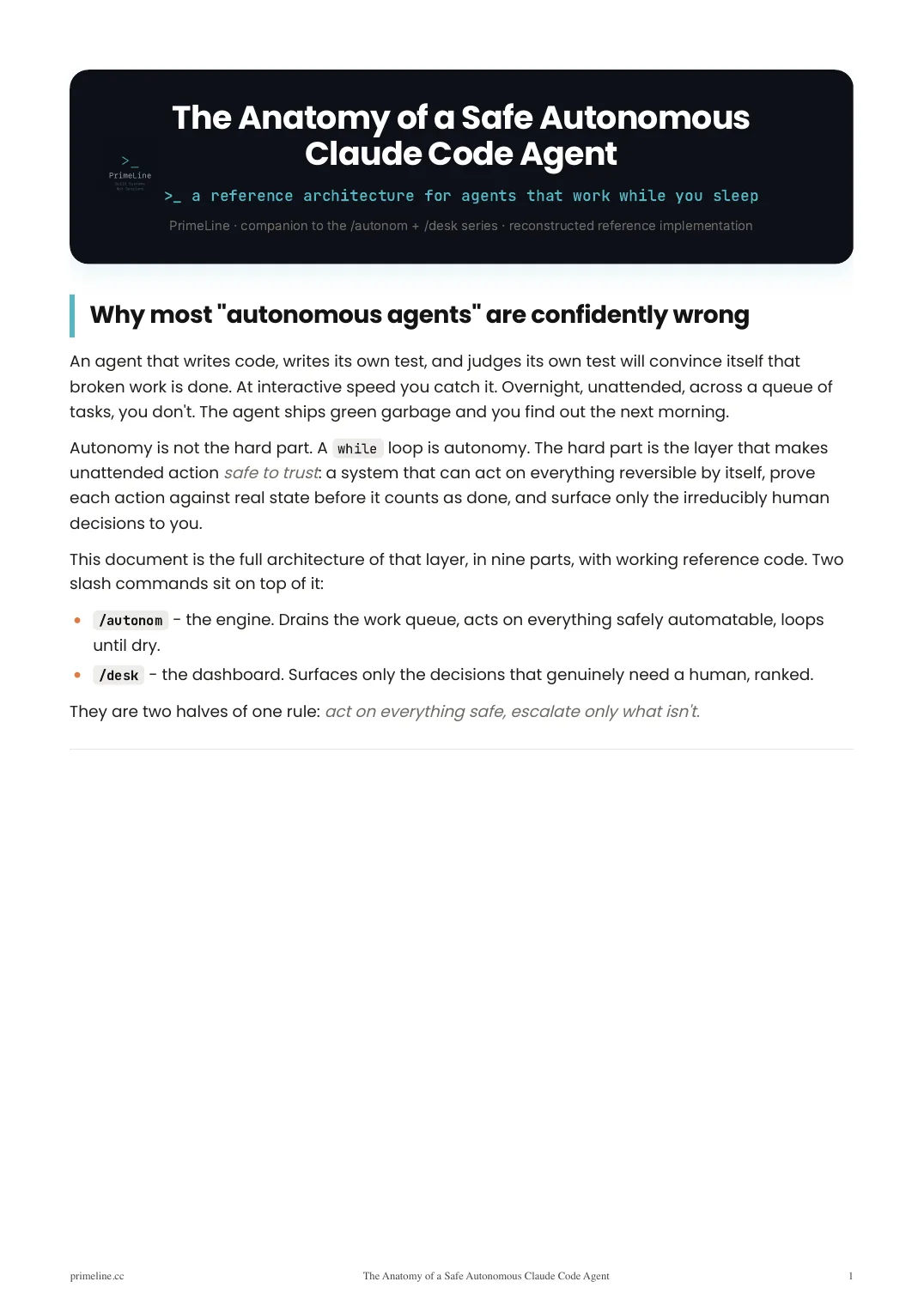
The Anatomy of a Safe Autonomous Claude Code Agent
The full reference architecture, with working code for all nine layers. Everything in this post plus the decision desk, in one document you can build from.
Download the PDF![Claude Code Human-in-the-Loop: The Decision Desk [2026]](/_next/image?url=%2Fblog%2Fclaude-code-human-in-the-loop-hero.webp&w=3840&q=75)
![Claude Code Verification: Why 'Done' Isn't Done [2026]](/_next/image?url=%2Fblog%2Fclaude-code-verification-hero.webp&w=3840&q=75)
![A Negative Result on Claude Code Agent Self-Regulation [2026]](/_next/image?url=%2Fblog%2Fcsra-negative-result-hero.webp&w=3840&q=75)