A Claude Code human-in-the-loop setup is supposed to keep you in control of your agent. Most of them do the opposite. They stop and ask you about everything, so you become the bottleneck, or they log every decision into a file you never read, so the important ones quietly rot next to the trivial ones. Either way the human is in the loop in the worst possible sense: drowning in it.
The fix is not more prompts and it is not fewer. It is a sorting problem. An autonomous Claude Code agent that acts on everything reversible by itself produces a small residue of decisions it genuinely cannot make alone. Those are the only things that should reach you, ranked so the urgent one is on top and nothing un-actioned ages out of sight. I run that residue through a single command I call the decision desk. This is how it works, with the real ranking code.
A Claude Code human-in-the-loop desk surfaces only the decisions an autonomous agent could not safely make alone, ranked by severity, age, irreversibility, and blast radius. Un-actioned items climb on their own, resolved ones drop off on their own, and the desk is silent when there is nothing for you. It is the human-facing half of autonomy: the agent acts on everything safe, the desk catches everything else.
Why autonomous still needs a human in the loop
Autonomy and human-in-the-loop are not opposites, they are two halves of the same system. An agent that runs unattended still hits decisions it should never make on its own: an irreversible change, a config behind a safety lock, a judgment call about taste or strategy. The skill of a good autonomous setup is not avoiding those, it is recognizing them and routing them to you instead of guessing.
The failure mode is what happens to that residue. If the agent stops mid-run to ask, you lose the autonomy. If it dumps every escalation into an append-only log, the log grows until the one decision that mattered this week is buried under forty that did not. I covered the acting half in the autonomous agent deep-dive; this post is about the other half, the part that decides what is worth interrupting you for.
- -Stops to ask after every batch
- -Dumps all escalations into a log
- -Trivial and critical look the same
- -Old decisions sink out of view
- -Pings you even when nothing's wrong
- +Acts on everything reversible itself
- +Surfaces only human-required calls
- +Ranked by severity x age x blast radius
- +Un-actioned items climb automatically
- +Silent when there is nothing for you
What belongs on the desk, and what doesn't
A decision belongs on the desk only if the agent could not safely resolve it alone. Everything reversible and in-scope the agent already did and logged. What is left falls into a few buckets: something irreversible, something behind a safety lock the agent is not allowed to touch, a due date that needs your call, or a strategic or taste judgment no rule can make.
This boundary is the whole point, and it is the same boundary that powers a good score-based delegation setup: the system is not deciding whether to act, it is deciding who should act. Reversible and clear goes to the agent. Irreversible or ambiguous goes to you. Getting that line right is what makes the desk short enough to actually read.
How do you rank decisions that need a human?
The desk ranks each decision by a single score, so the most urgent one is always on top. The score multiplies four factors: how severe it is, how long it has waited, how irreversible inaction is, and how big the blast radius would be. An acknowledged-but-unresolved item is halved, so things you have seen but parked sink below fresh ones.
SEVERITY = {"P0": 4.0, "P1": 3.0, "P2": 2.0, "P3": 1.0}
BLAST_KEYWORDS = ("security", "credential", "password", "secret", "token",
                  "auth", "data-loss", "production", "deploy", "delete", "schema")

def rank(d, now):
    sev = SEVERITY.get(d.severity, 1.0)
    age_days = max(0.0, (now - d.first_seen_ts) / 86400.0)
    age_factor = 1.0 + age_days / 7.0              # +1 per un-actioned week
    blob = (d.title + " " + d.detail).lower()
    blast = 2.0 if any(k in blob for k in BLAST_KEYWORDS) else 1.0
    ack_penalty = 0.5 if d.acknowledged else 1.0
    return sev * age_factor * d.irreversibility * blast * ack_penalty
The numbers are deliberately blunt. A P0 starts at four times a P3. Anything that mentions a credential or a production deploy doubles. Irreversibility is a small per-type weight: a due date or an audit is more irreversible-by-inaction than a routine cleanup. None of this needs to be precise, it just needs to put the right thing on top, and a blunt multiplicative score does that reliably.
Free escalation: un-actioned items climb on their own
The most useful property of the desk is that nothing rots, and it costs nothing to maintain. An item's first-seen timestamp is simply the minimum timestamp across every time it has ever been emitted into the append-only history. So age_factor grows by one point per week automatically, and an item you keep ignoring climbs the ranking on its own until you deal with it.
The trick is that there is no separate "first seen" tracker to keep in sync. The append-only log of emissions is the first-seen source: take the oldest row for each decision and you have its age for free. This is the same instinct behind durable session-to-session memory: the cheapest state is the state you can recompute from a log you already keep, instead of a second file that can drift.
Current, not ever-seen
The opposite problem is just as important: a decision that no longer applies should disappear without anyone pruning it. The desk handles this by reading only each producing module's latest run. If a check stops reporting a finding, because it got resolved or simply no longer detects anything, that finding drops off the desk on its own at the next run.
So the desk always shows the current state, never the historical pile. There is no cleanup job, no "mark as stale," no cron sweeping old entries. A decision is on the desk if and only if its source still emits it in its most recent run and you have not yet acted on it. Live in, resolved out, automatically.
The lifecycle: resolve, defer, drop, acknowledge
Acting on a decision is an append-only event, never a mutation of the findings themselves. You can resolve it (decided and done), defer it until a date, drop it (will not do), or acknowledge it (seen, keep it but deprioritize). The desk reads these back with latest-action-wins, so your most recent action on an item is the one that counts.
def is_open(key, latest_action, today):
    row = latest_action.get(key)
    if not row:                       return (True,  False)   # never touched
    action = row["action"]
    if action in ("resolve", "drop"): return (False, False)   # gone
    if action == "ack":               return (True,  True)    # visible, deprioritized
    if action == "defer":
        until = row.get("until")
        if not until:                 return (False, False)   # deferred indefinitely
        return (today >= until, False)                        # resurfaces on the date
    return (True, False)
Two details make this safe. The findings stream is never rewritten, so the desk can always reconstruct the truth from the append-only ledger, the same locked-append discipline that stops concurrent writers from eating each other's data. And an acknowledge after a resolve re-opens the item, so a thing you closed by mistake comes back instead of vanishing. The lifecycle is reversible, which is the same property that makes the autonomous half safe to run.
Silent when empty
The desk is silent when there is nothing for you. No "0 decisions pending," no green checkmark, no daily summary that trains you to ignore it. If the badge shows up, it is because something genuinely needs a human, and that is exactly why you will still read it on the day it matters.
This is the anti-nag principle, and it is harder to hold than it sounds. The temptation is to always show something so the feature feels alive. Resist it. A notification surface that fires when there is nothing to say is a notification surface you will mute, and a muted desk is worse than no desk, because now the important decision is both un-surfaced and assumed-handled. Silence is the feature.
This lives in primeline-ai/evolving-lite - the self-evolving Claude Code plugin. Free, MIT, no build step.
The two halves of one system
Put the two halves together and you get the whole point of the design: the agent acts on everything reversible by itself, and the desk surfaces only the decisions that genuinely need you, ranked. One half maximizes what gets done without you. The other half minimizes what gets escalated to you. Together they are a system that runs mostly on its own and interrupts you exactly when it should.
This is the human-in-the-loop pattern done as separation of duties rather than constant supervision, the same idea behind team guardrails for multi-agent setups. You are not in the loop on every step. You are in the loop on the decisions that are actually yours, and nowhere else. That is the difference between supervising an agent and being buried by one.
Build your own: the checklist
If you are adding a human-in-the-loop desk to your own Claude Code setup, these are the properties that make it work instead of becoming another ignored log:
- Only decisions the agent could not safely make alone reach the desk.
- Each is ranked by severity, age, irreversibility, and blast radius.
- Age is derived from the append-only log, so un-actioned items climb for free.
- Only the latest run of each source counts, so resolved items drop off on their own.
- Acting is append-only and reversible: resolve, defer, drop, acknowledge.
- The desk is silent when there is nothing that needs you.
The decision desk is the human-facing half of the autonomous system in the eight-layer deep-dive. The full architecture, with the complete ranking and lifecycle code for both halves, lives in the companion reference document below.
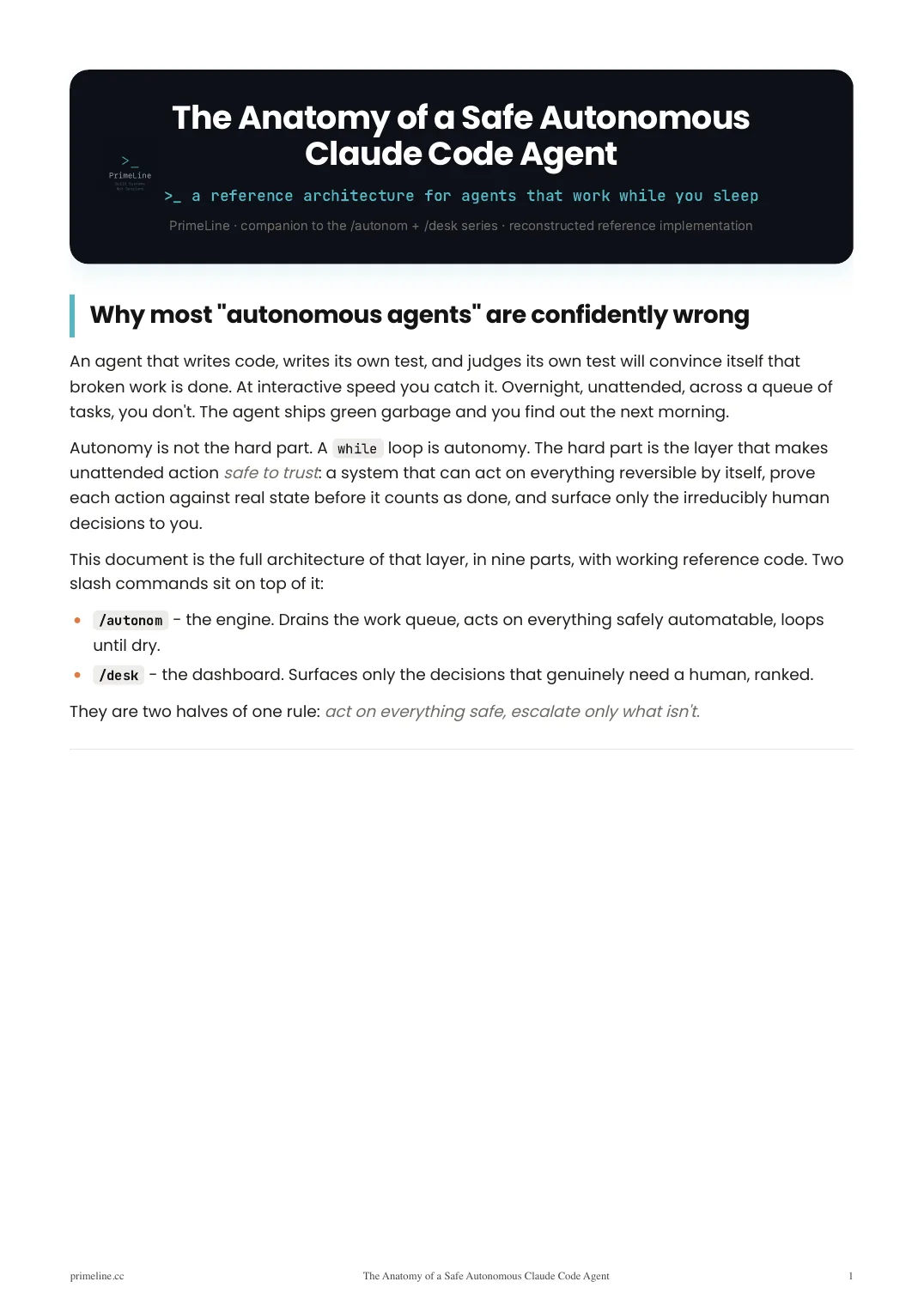
The Anatomy of a Safe Autonomous Claude Code Agent
The full reference architecture, with working code for all nine layers including the decision desk. One document you can build from.
Download the PDF