Claude Code Has Persistent Memory Now. Here is Where It Stops.
When I wrote this in March 2026, Claude Code wrote nothing down on its own. CLAUDE.md existed, but that is a file you author - anything Claude learned during a session left with the session. So you built that half yourself: a _memory/ folder, a bootup ritual, a log at session end. I described exactly that in the memory system post.
That is no longer the starting point. Claude Code ships auto memory, it is on by default, and Claude writes notes to itself based on your corrections and preferences. They live in ~/.claude/projects/<project>/memory/, and Claude loads the top of that index at the start of every session. So the problem this post opened with - nothing survives unless you write it down - is solved, and solved by the tool.
What auto memory does not do is the reason the rest of this post still stands. Per Anthropic's own docs: only the first 200 lines or 25KB of MEMORY.md load at session start, and anything past that is not loaded then. Detail lives in topic files that are not loaded at startup - Claude reads them on demand. Claude "doesn't save something every session. It decides what's worth remembering." The store is machine-local and per-repository, so it does not follow you to another machine, and subagents do not inherit it - a fork is the one exception. And both auto memory and CLAUDE.md are treated as context, not enforced configuration.
So the gap moved. It is no longer "there is no memory". It is that the memory is a capped index of whatever Claude judged worth keeping, on one machine, in prose. You can read it and edit it - the files are plain markdown and /memory opens them - but there is nothing to query. Ask "what have I decided about authentication?" and the only answer is a file search. That is what Evolving Lite addresses, and the rest of this post is how.
The Problem: Claude Code Memory Files Do Not Scale
The _memory/ folder approach solved the stateless session problem before auto memory existed, and the maintenance cost it introduced is the same one auto memory now inherits: something has to decide what is worth keeping, and keep it short enough to load.
After 60+ sessions running the manual system, I noticed a pattern. The memory files were only as good as my discipline at session end. When I was tired, I'd skip logging. When I was in flow, I'd forget entirely. The system degraded exactly when I was most productive.
Three failure modes showed up repeatedly:
- Architecture decisions made in session 12 were invisible by session 40
- The same code mistakes resurfaced because lessons lived in flat JSON, not a queryable graph
- Self-correction - learning from a code fix - required me to write a log entry manually, immediately, or the learning was lost
Auto memory softens all three and closes none of them. It writes without being asked, which is the real win, and it is the third failure mode that shrinks most. But it still decides for itself what is worth keeping, it still hands the next session a capped index rather than a graph, and a lesson from session 12 is still a line of prose that nothing can query by concept in session 40.
The system needed to get smarter on its own, not just remember what I told it.
The Solution: Evolving Lite + Kairn
Evolving Lite is an open-source Claude Code plugin. Kairn is a persistent knowledge graph MCP server. Together they replace the manual memory ritual with a self-evolving system.
The core shift: instead of Claude Code reading flat files I maintain, it reads and writes a structured knowledge graph that grows automatically as you work.
- -Claude decides what is worth saving
- -Index capped at 200 lines / 25KB per session
- -Notes and flat JSON, not queryable by concept
- -Machine-local, scoped to one repository
- -Anything beyond that is your session-end discipline
- +Architecture decisions saved automatically
- +Bootup loads your full knowledge graph in seconds
- +Knowledge graph queryable by concept and tag
- +Code fixes trigger automatic learning events
- +Cross-project recall, and yours to move or back up
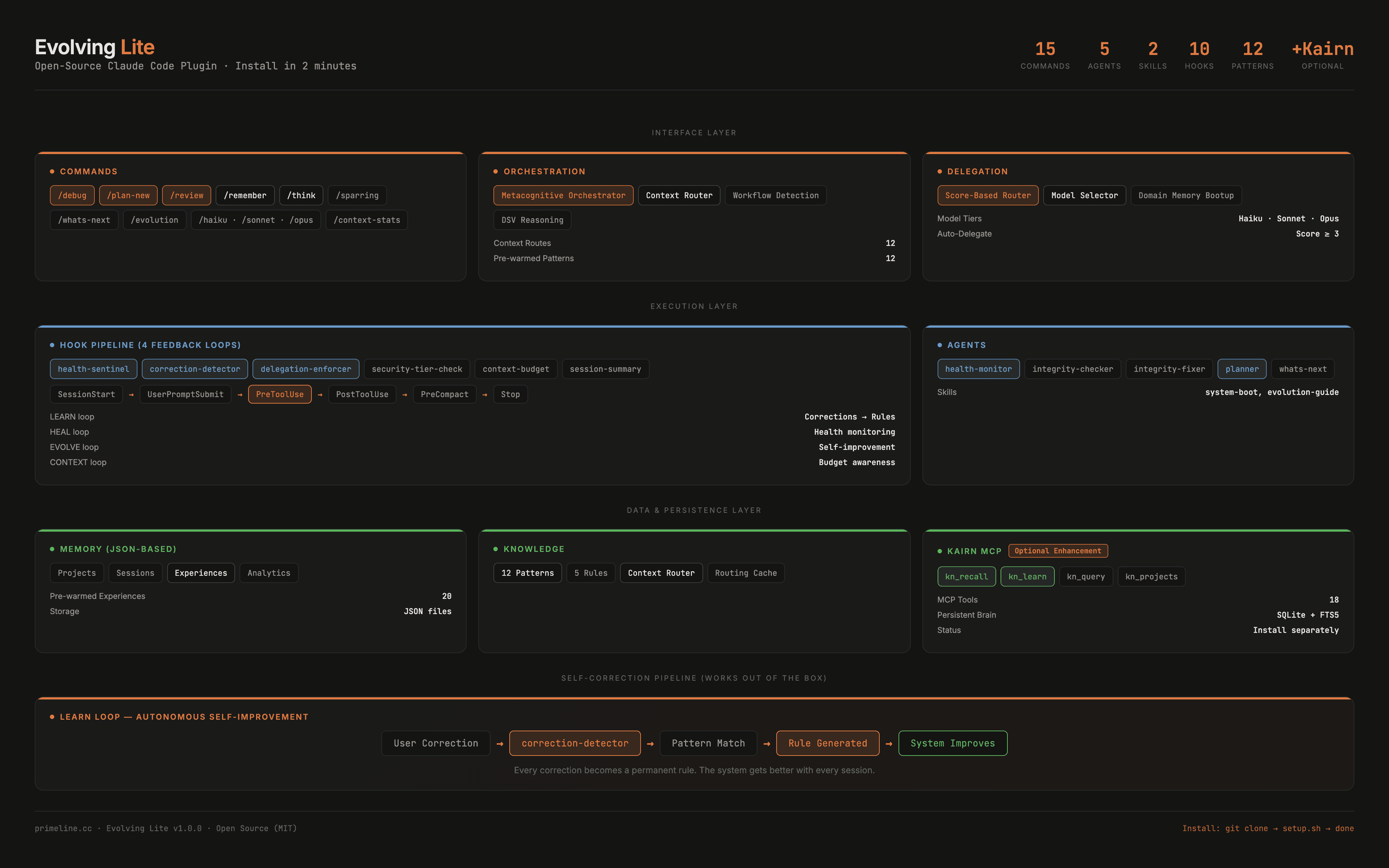
When Kairn boots up in a session, it loads the full project context: active projects, knowledge nodes, past experiences. In the demo video, that is 3 projects, 37 knowledge nodes, and 25 experiences - all available before Claude writes a single line of code.
Persistent Memory in Action (Demo)
The demo walks through six stages. Here is what each one means in practice.
Stage 1 - Bootup. Claude queries Kairn at session start and gets back a structured context payload. Not a flat file. A graph of concepts, relationships, and experiences that were built up over previous sessions. The session starts at full knowledge in under 10 seconds.
Stage 2 - Knowledge Recall Before Codebase. This is the part that changed how I work most. Before searching the file system, Claude queries the knowledge graph. If an architecture decision exists - "we use SHA-256 for token hashing, not base64url" - Claude retrieves it before touching a single file. The codebase search confirms; the knowledge graph informs.
Stage 3 - Live Learning. During the session, when a new architecture decision is made, it gets saved as a permanent knowledge node. Not a log entry. A node with relationships to other concepts in the graph. Next session, it is part of the bootup context. No manual step required.
Stage 4 - Contextual Code Review. Claude reviews a code segment using stored architecture decisions as the reference frame - not just the code itself. The review is grounded in decisions the system has actually tracked, not abstract best practices.
Stage 5 - Code Fix. The demo shows replacing insecure base64url encoding with SHA-256 hashing. Standard fix. But what happens next is not standard.
Stage 6 - Self-Correction Without Intervention. After the code change, the system automatically logs the fix as a learning event. No manual entry. No prompt. The pattern - "base64url encoding is insecure for token generation" - becomes a permanent knowledge node. Next time Claude encounters base64url in a security context, it flags it from memory, not from inference.
What Changes After Using It
The difference persistent memory makes is not just convenience. It is the compounding effect.
Every session adds to the knowledge graph. Architecture decisions made in week one are still active context in week eight - not because you remembered to maintain a file, but because the graph is append-only and queryable. The system does not forget unless you tell it to.
The self-correction loop is the piece I underestimated. In self-correcting Claude Code workflows, I wrote about hooks that detect context drift mid-session. Evolving Lite extends that idea across sessions. A lesson learned from a code fix in session 30 is available in session 31 without any manual transfer.
For teams exploring knowledge architecture patterns, Kairn's graph structure also means knowledge is organized by concept relationships - not just chronological logs. You can query "what decisions relate to authentication?" and get a structured answer, not a file search.
The numbers from the demo: 37 knowledge nodes, 25 experiences, 3 active projects - all loaded in the bootup phase. That is persistent memory that travels with your workflow, not a document you have to maintain.
Why Open Source Matters Here
Both Evolving Lite and Kairn are open source. That is a deliberate choice.
Memory systems are intimate. They know your architecture decisions, your past mistakes, your in-progress work. Trusting that to a closed system means trusting a vendor with your intellectual context. Open source means you own the graph, you own the data, you can inspect every read and write.
It also means the system is transparent. When Claude queries Kairn and retrieves a knowledge node, you can see exactly what was stored and why. No black box. The hooks automation patterns that power the self-correction loop are all visible and modifiable.
The Honest Part
First version of this system was rough. The bootup loaded too much context - everything in the graph, regardless of relevance. Sessions started slow. Claude spent the first few exchanges processing context rather than working.
The current version uses relevance scoring. Bootup loads nodes above a confidence threshold, not the full graph. The session starts fast because the context is filtered, not just fetched.
That iteration took about two weeks. If you set this up yourself, expect the same calibration period. The system works on day one, but it gets meaningfully better once you have 10-15 sessions worth of knowledge nodes built up.
Get Started
Both tools are free and open source:
- Evolving Lite - Claude Code plugin.
git cloneinto~/.claude/skills/+bash setup.sh. Done - anything with a plugin manifest under that directory loads on the next start. - Kairn - Knowledge graph MCP server.
pip install kairn-ai. Optional but recommended for semantic search.
This lives in primeline-ai/evolving-lite - the self-evolving Claude Code plugin. Free, MIT, no build step.
![Open Source Alternative to Mem0 for Claude Code [2026]](/_next/image?url=%2Fblog%2Fopen-source-mem0-alternative-hero.webp&w=3840&q=75)