Claude Code Adaptive Research Replaces Your Manual Workflow
You have a question - "How would ant colony optimization apply to my database sharding?" - and then spend 45 minutes bouncing between ChatGPT, Google Scholar, Reddit, and Hacker News. Copy-pasting snippets. Losing tabs. Forgetting which source said what. And the worst part: every insight is generic. Nobody mapped those findings to YOUR architecture.
Claude Code adaptive research eliminates that entire loop. One command. Walk away. Come back to a quality-gated report where every finding is adapted to your projects, your role, your goals.
A Claude Code plugin that runs autonomous research loops with personalized adaptations, compound learning between runs, and a 4-criteria quality gate that rejects bad output automatically. Clone it, load it, run its auto-run command, get reports tailored to your work. Open source.
Want foundational patterns first? The free 3-pattern guide covers memory, delegation, and knowledge graphs at concept level.
Why Is AI Research Still Manual?
Sounds weird in 2026, but most AI-assisted research is still a conversation. You ask, it answers, you ask again. Even tools like Perplexity and Gemini Deep Research produce single-shot reports. You read them once, extract what matters manually, and start over next time.
Three problems with that:
No memory. Every research session starts from zero. That trend you spotted last Tuesday? Gone. The keyword that almost connected two ideas? Forgotten. You are the only persistent layer, and your memory is not great at 11pm.
No personalization. A report about swarm intelligence reads the same whether you build SaaS products or embedded systems. The adaptation from finding to action happens entirely in your head. Every single time.
No quality control. Half-baked outputs waste your time. You skim a 2000-word report, realize 80% is filler, and close the tab. No mechanism to enforce depth or originality.
- -45 min per topic, copy-paste across 5 tabs
- -Generic findings, zero project context
- -No memory between sessions
- -Quality varies wildly
- +One command, walk away
- +Findings mapped to YOUR projects
- +Compound learning across runs
- +Quality gate rejects bad output
How Does Claude Code Adaptive Research Work?
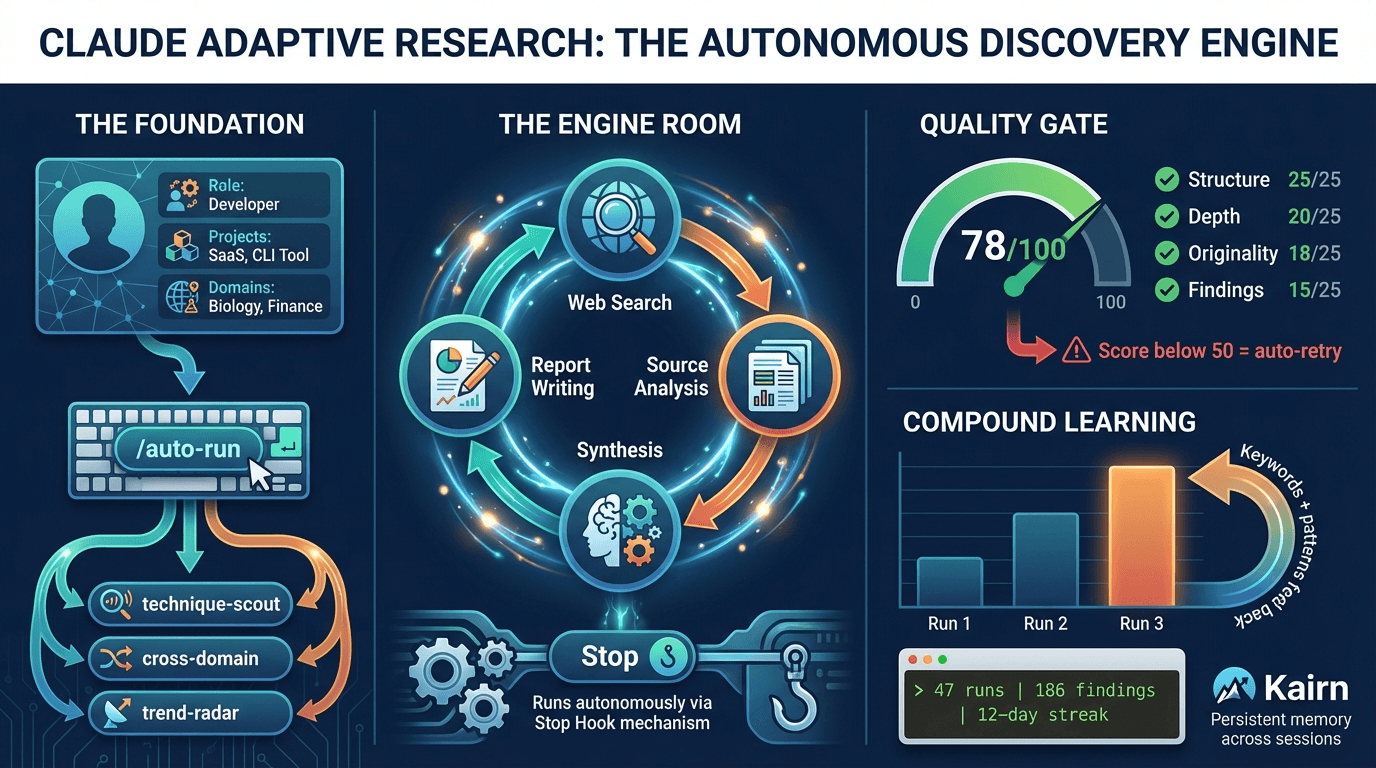
The plugin is on GitHub at primeline-ai/claude-adaptive-research. Clone it and load it with claude --plugin-dir <path>, which loads it for that session only, without installing it. First run triggers a 2-minute guided setup - pick your research domains, answer a quick profile interview about your projects and goals. That profile drives every report from now on.
Then it is one command:
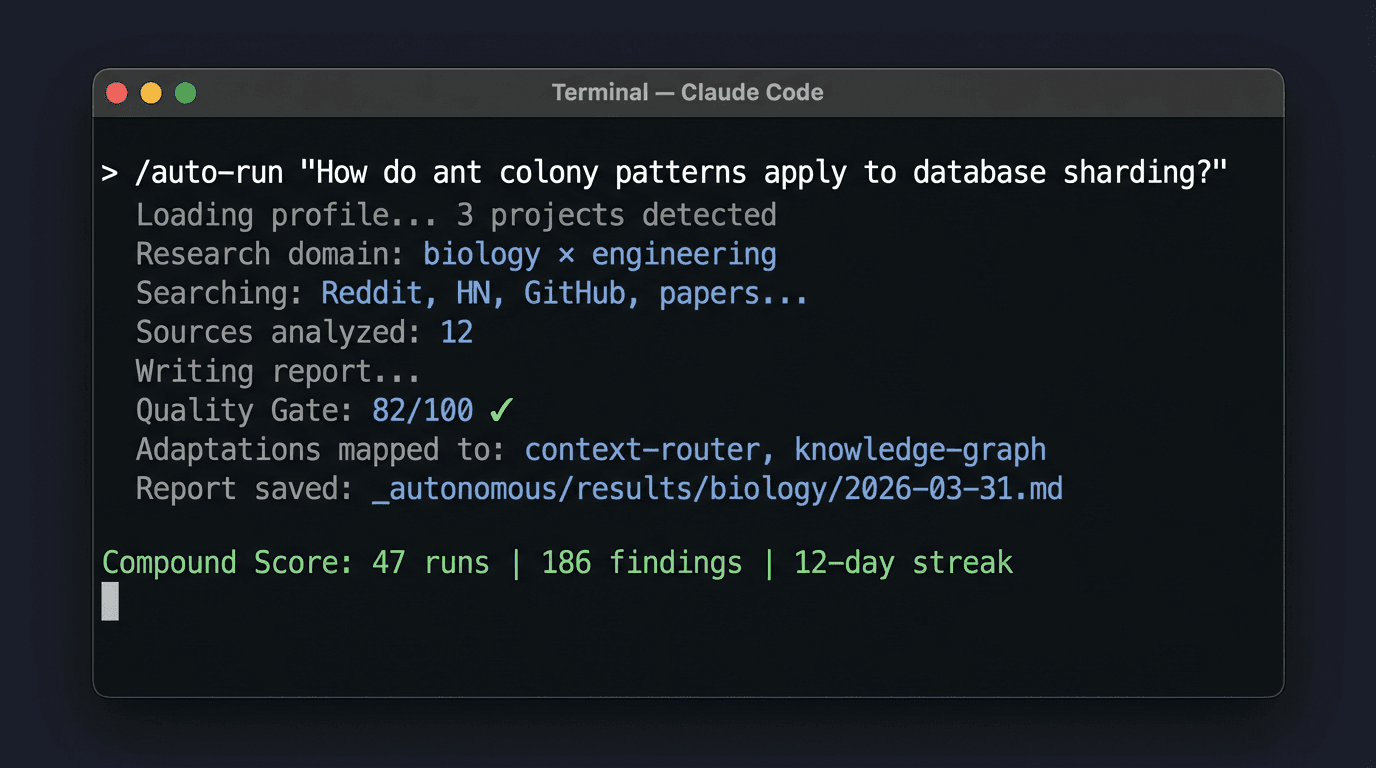
/claude-adaptive-research:auto-run "How do ant colony patterns apply to database sharding?"
Claude researches autonomously - searching the web, reading sources, synthesizing findings. No babysitting. The Stop hook mechanism keeps the loop running across turns without you touching the keyboard.
Personalized Adaptations: Not Generic Advice
This is the part that makes it different from every other research tool. During setup, you tell the plugin about your projects. Name, stack, current challenges. That context gets injected into every single research run.
A biology finding about swarm intelligence does not just explain the concept. The report includes an Adaptations section that maps it directly to your SaaS architecture or your open-source library. By name. With concrete suggestions. That mapping is a discipline of its own, and I wrote up how it works in cross-domain system design.
I run 10 research domains across my own projects. A finding about PageRank in my "mathematics" domain gets adapted to my context router. A finding about evolutionary feedback loops gets adapted to my knowledge graph. Every report speaks directly to my work. Not a single generic paragraph.
Compound Learning: Run 2 Is Smarter Than Run 1
Here is where it gets wild. After each completed run, the plugin saves keywords, patterns, and follow-up questions to a feedback state file. Next run, those get injected as additional search context.
Run 1 discovers the vocabulary. Run 2 searches deeper using that vocabulary. Run 3 connects cross-domain patterns that Run 1 could not have found. This is what makes it adaptive, not just autonomous.
The compound score tracks your momentum: total runs, findings discovered, streak days. Research becomes a habit with visible progress.
If you have Kairn installed, top findings get saved to your knowledge graph automatically. Next time you research a related topic, the plugin recalls what you already know and skips it. No re-discovery. Pure forward progress.
Quality Gate: No Half-Baked Reports
Every report gets scored on 4 criteria, each worth 25 points:
Score below 50? Claude automatically improves the report and loops again. No half-baked outputs reach your results folder. After 3 failed attempts, it ships anyway with a quality warning - fail-open, not fail-silent.
The originality check compares against YOUR previous reports in the same domain. It prevents the loop from regurgitating last week's findings with different words.
This lives in primeline-ai/claude-adaptive-research - the adaptive research plugin. Free, MIT, no build step.
5 Presets for Common Research Needs
You can research any free-text topic, but presets give you optimized strategies:
| Preset | What It Finds | Best For |
|---|---|---|
technique-scout | New techniques and tools in your field | Staying current |
cross-domain | Patterns transferred between disciplines | Innovation |
trend-radar | Emerging trends with timing analysis | Spotting opportunities |
content-pipeline | Research + draft article in one loop | Content creation |
competitor-analysis | Reverse-engineer top performers | Competitive intelligence |
Each preset tunes the quality gate thresholds, search strategy, and output format. cross-domain requires documenting where each analogy breaks. competitor-analysis saves competitor names for future runs. All fully customizable.
For batch research overnight, the plugin includes tmux integration with a watchdog that handles rate limits and session recovery automatically.
Before and After: 6 Months of Daily Research
I extracted this plugin from a production system after months of daily autonomous research. Real numbers:
| Metric | Before (Manual) | After (Adaptive) |
|---|---|---|
| Time per research topic | 45 min active | 0 min active (background) |
| Findings per week | 5-8 scattered notes | 15-25 structured reports |
| Cross-domain connections | Rare, accidental | Systematic via compound learning |
| Knowledge retention | Browser bookmarks | Organized by domain + Kairn memory |
The plugin is MIT licensed and open source. Works with Claude Max/Pro subscriptions at no extra cost, or ~$2-8 per run on API billing.
git clone https://github.com/primeline-ai/claude-adaptive-research
claude --plugin-dir ./claude-adaptive-research
Clone it, start Claude Code with one flag. One command to research. Everything else is automatic.
Updated 2 October 2026: the install instructions now use the documented --plugin-dir flag, which loads the plugin for one session.