
Your Claude Code System Hit a Wall. The Fix Is Not in an AI Paper.
You built agents. Added rules. Configured a knowledge graph. Your Claude Code system grew to 60+ skills, 200+ knowledge nodes, and a context router with 240 routes. Then everything started to break in slow, invisible ways. Routes went stale. Agents picked the wrong model. Knowledge that should have surfaced stayed buried.
So you did what every developer does. You read AI papers. You scrolled AI Twitter. You tried the latest MCP server. Nothing moved the needle.
The answer was not in computer science. It was in a biology textbook, a 1998 math paper, quantum physics, and a philosophy book. Every breakthrough in my Claude Code system architecture came from outside CS - and the same approach works for yours.
Nature and science already solved the hardest problems in AI system design - routing, knowledge ranking, multi-perspective analysis, and fault tolerance. Five cross-domain adaptations turned a brittle Claude Code setup into a self-improving system. All components are open source.
Why Cross-Domain Thinking Beats AI-Only Optimization
Most developers optimize their Claude Code systems by looking at what other Claude Code users do. That is an echo chamber. The problems you face - routing at scale, knowledge curation, reasoning drift, error recovery - were solved decades or billions of years ago in other fields.
The approach is straightforward: find a mechanism in nature or science that solves a structural problem, then adapt the core principle into code. Not metaphors. Not inspiration boards. Actual running implementations with measurable before-and-after results.
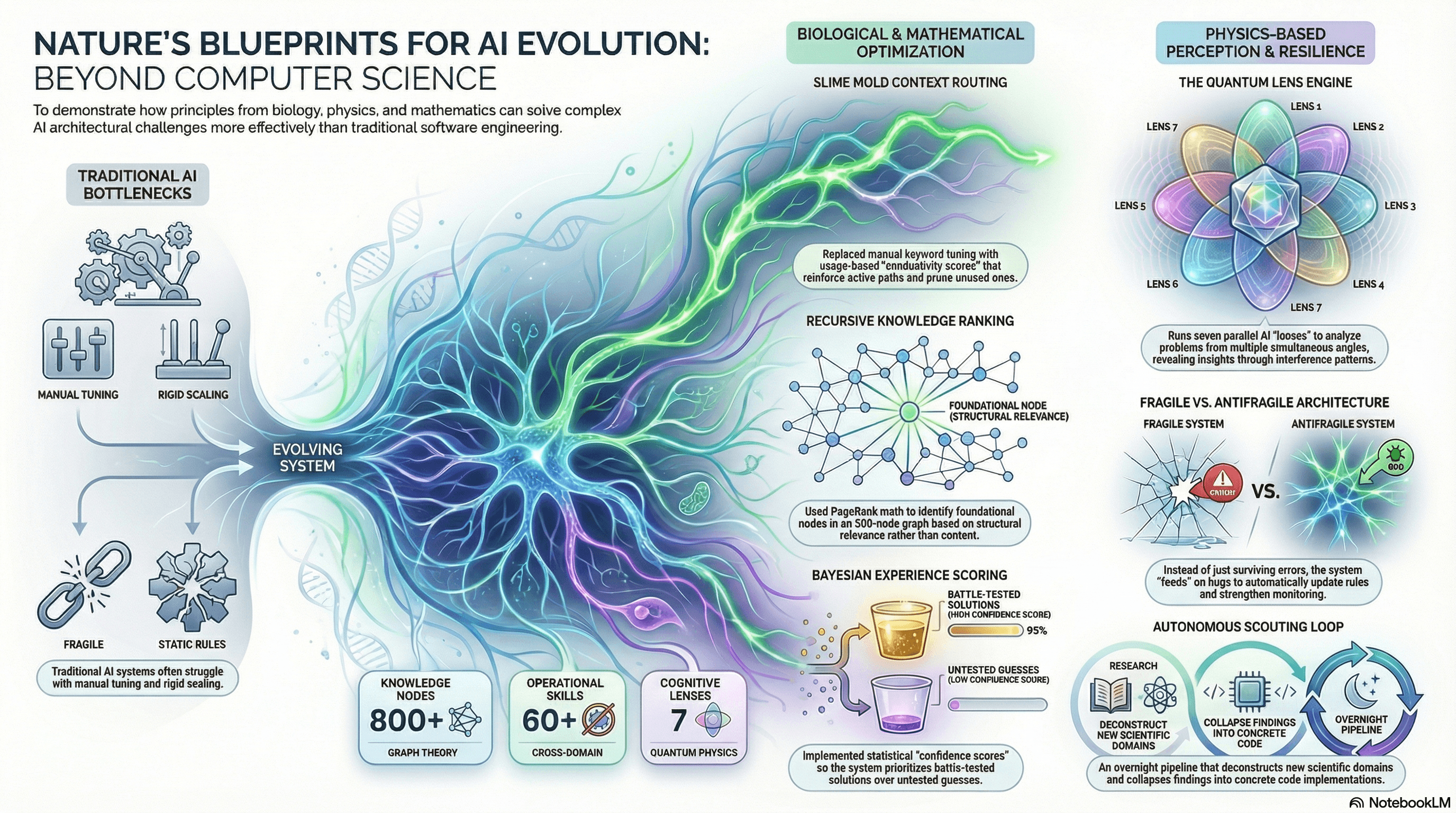
Here are five adaptations running in production right now.
1. A Brainless Slime Mold Fixed My Routing
My context router had 240+ routes - all static keyword matches I configured manually, sitting under the score-based auto-delegation layer that decides which agent gets a task. When the system grew past 200 knowledge nodes, I could not keep up. Routes were stale, some never got used, others were missing entirely. I spent weeks tweaking keywords by hand, and every time I added new knowledge, old routes broke.
Then I read about Physarum polycephalum. It is a single-celled organism with zero neurons that builds transport networks matching Tokyo's rail system in efficiency. In the famous Tokyo experiment, scientists placed food on a map matching 36 cities around Tokyo. The slime mold connected them all - optimizing for efficiency, fault tolerance, and cost simultaneously. No central planner. No optimization function. Just one local rule applied everywhere. Published in Science by Tero et al., 2010.
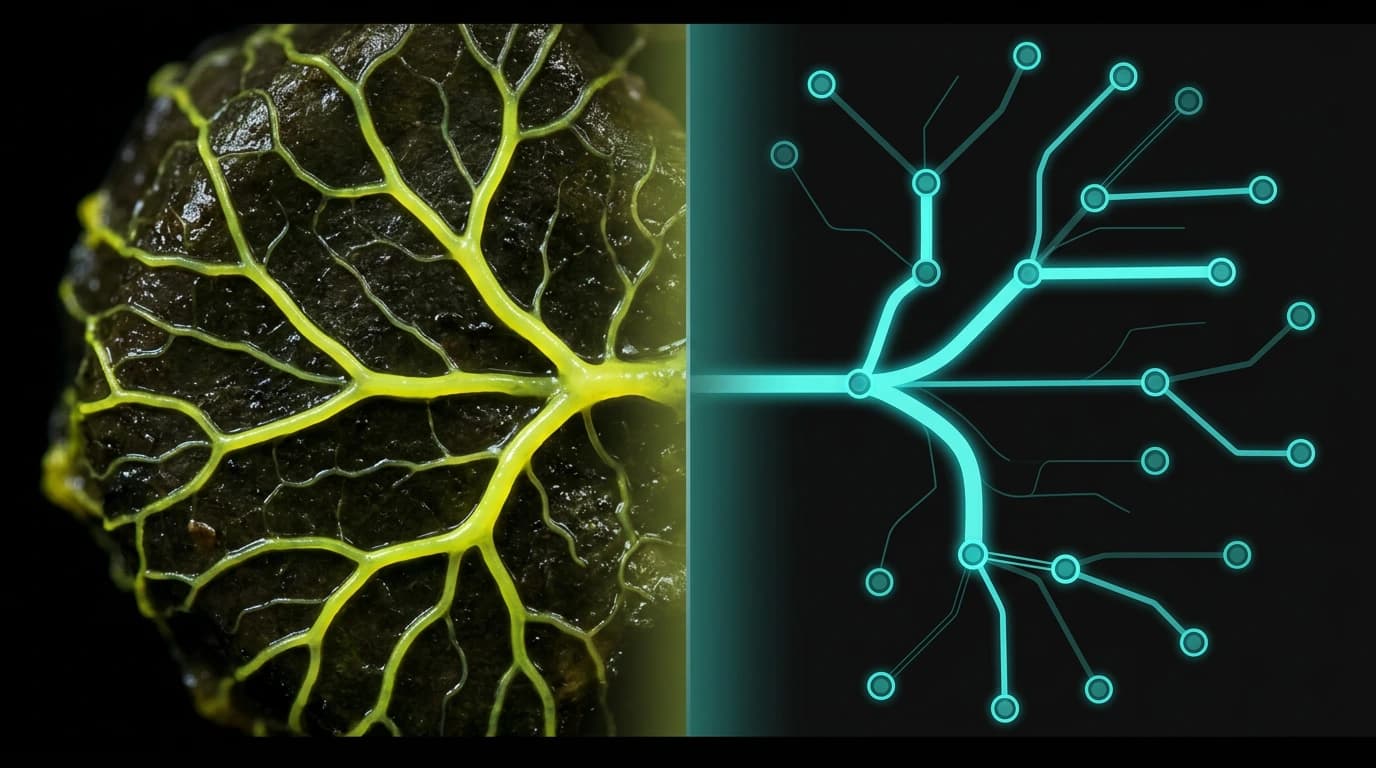
The core mechanism is dead simple: tubes that carry more flow get thicker. Tubes with less flow shrink and disappear. Local feedback creates globally optimal networks.
I took that exact principle and applied it to my context router. Every route now has a conductivity score. When a route gets used, its score increases. Every session without a hit, it decays.
Here is the simplified conductivity update - the core of the Physarum adaptation:
# route-conductivity.py (simplified)
FLOW_BOOST = 0.15
DECAY_FACTOR = 0.95

def update_routes(routes, accessed_routes):
    for route in routes:
        if route["key"] in accessed_routes:
            route["conductivity"] *= (1 + FLOW_BOOST)
        else:
            route["conductivity"] *= DECAY_FACTOR
    return routes
Two constants. One loop. Routes that get used grow stronger. Routes nobody touches fade. The full production version adds minimum thresholds and normalization, but this captures the entire principle. Twenty lines of Python replaced weeks of manual keyword tuning - and the system now adapts to how I actually work, not how I predicted I would work.
- -240 static routes with manual keyword matches
- -Weeks of maintenance when system grew
- -Routes went stale without detection
- +Self-adapting conductivity scores
- +Used routes strengthen, unused routes decay
- +20 lines of Python replaced manual tuning
2. Google's 1998 Algorithm Ranks My Knowledge
800+ nodes in my knowledge graph. Which ones are foundational and which are noise? I was deciding manually. That does not scale past 100 nodes, let alone 800.
PageRank solved this problem in 1998 for the entire internet. It does not care what a page says - it cares who links to it. A page referenced by many important pages is itself important. Recursive structural relevance without any content analysis.
I pointed that math at my knowledge graph. 980+ edges between nodes. Instead of me deciding what matters, the graph structure tells me. Nodes that many other nodes reference surface as foundational knowledge. Nodes nobody points to become archive candidates. The math that organized the internet now organizes my Claude Code system's memory.
The real insight was not the algorithm itself. It was realizing that my knowledge graph IS a web - and the tools to rank webs have existed for almost three decades.

3. Quantum Physics Gave Me a Perception Engine. That Engine Found Everything Else.
This is the one that changed the game. And here is why it matters more than the other four combined.
I was stuck analyzing problems the way every developer does - one perspective, one mental model, one pass. Then I studied quantum superposition: a particle exists in multiple states simultaneously until you observe it. And interference patterns: when waves overlap, they either amplify or cancel each other, revealing hidden structure.
That is not a metaphor. It is a design pattern.
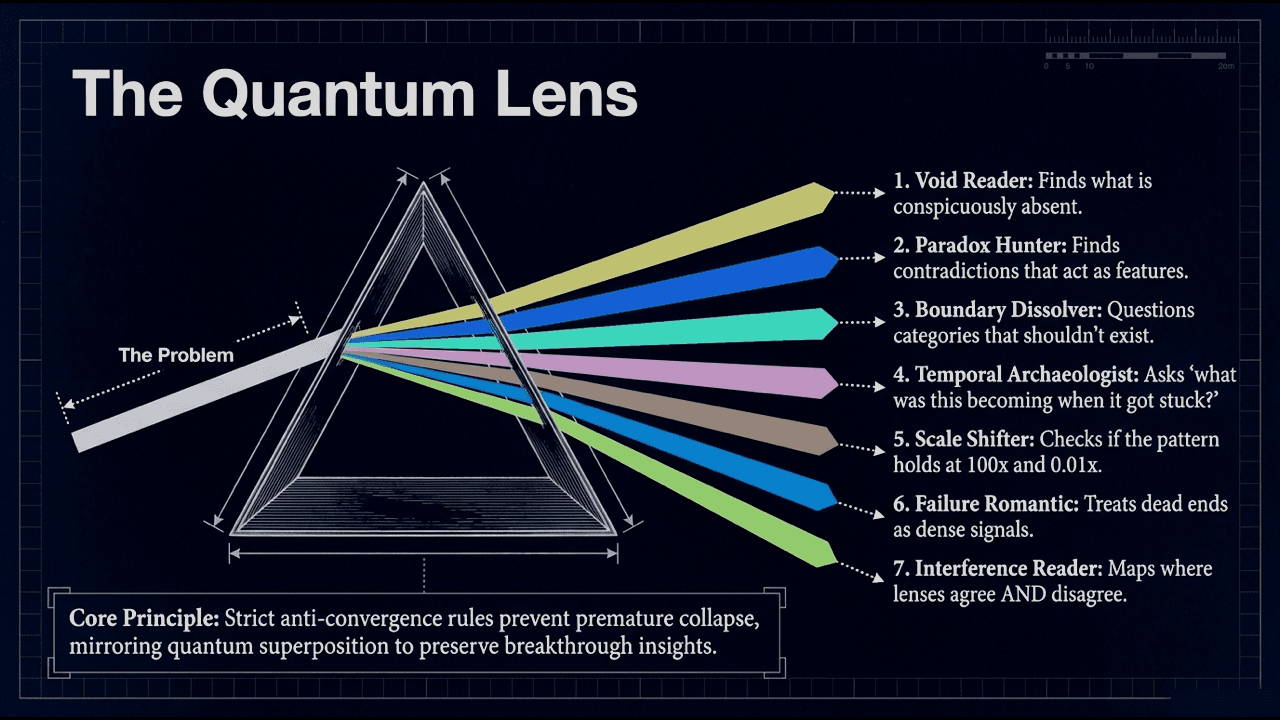
I built Quantum Lens directly from these two principles. Seven cognitive lenses - each one a separate Claude Code agent running in parallel, each one designed to see what the others structurally cannot. That last part is the whole point, because agents given the same framing tend to agree with each other and agreement is not evidence:
- Void Reader - finds what is conspicuously absent. The silence IS the signal.
- Paradox Hunter - finds contradictions that are actually features, not bugs.
- Boundary Dissolver - questions categories that should not exist.
- Temporal Archaeologist - asks "what was this becoming when it got stuck?"
- Scale Shifter - checks if the pattern holds at 100x and 0.01x.
- Failure Romantic - treats dead ends as information-dense signals.
- Interference Reader - maps where lenses agree AND disagree.
The key: strict anti-convergence rules. These agents are not allowed to agree too easily - like the uncertainty principle, premature collapse destroys information. The real insights live in the interference patterns between lens outputs. Where two lenses contradict each other? That is where the breakthrough hides.
Then I needed the second half. Perception without action is philosophy. So I built Solution Engine - the 'measurement' that collapses the quantum state into concrete, implementable solutions. Perception engine observes from all angles. Solution Engine collapses into code.
One workflow chains both: /quantum-full. It scored 8.6 on a real client requirements analysis. Surfaced five breakthrough insights the client had not considered in months of planning - including a killer question that reframed their entire verification architecture.
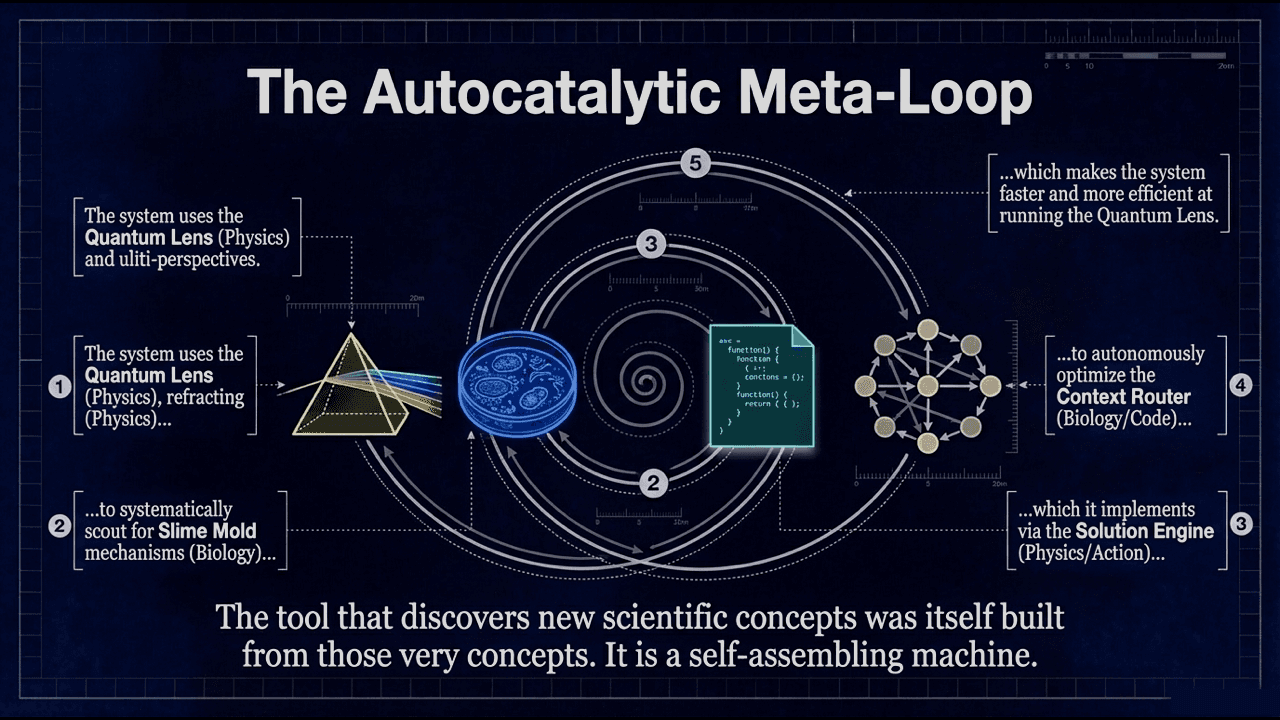
But here is the part that matters most: Quantum Lens is what found most of the other concepts on this list. The Physarum adaptation? Found by running /auto-run cross-domain - which uses Quantum Lens to deconstruct biological mechanisms and Solution Engine to map them onto my system's actual problems. The tool built from quantum physics finds the biology that fixes the routing that improves the system that runs the tool.
That is the loop. That is why one workflow can change everything.
4. Bayesian Statistics Made My System Learn from Experience
My system stores experiences - what worked, what failed, what was learned. But initially every experience had the same weight. A solution discovered yesterday was treated the same as one proven 50 times over three months.
Bayesian updating fixed this. The same math that lets doctors refine diagnoses with each patient lets my system update confidence scores with each use. Prior belief plus new evidence equals posterior belief.
Every successful knowledge retrieval - confidence goes up. Every failed retrieval - it drops. Started with flat 0.5 confidence across everything. After three months of Bayesian updates, the system knows which experiences to trust and which to question. No manual labeling. No training data. The math runs itself.
The difference in practice: my system now prioritizes battle-tested solutions over fresh guesses. Experience that has been validated 20 times surfaces before experience that worked once. The system gets better with every interaction - not because I tuned it, but because Bayesian math tunes itself.
5. Nassim Taleb Taught My System to Get Stronger from Failure
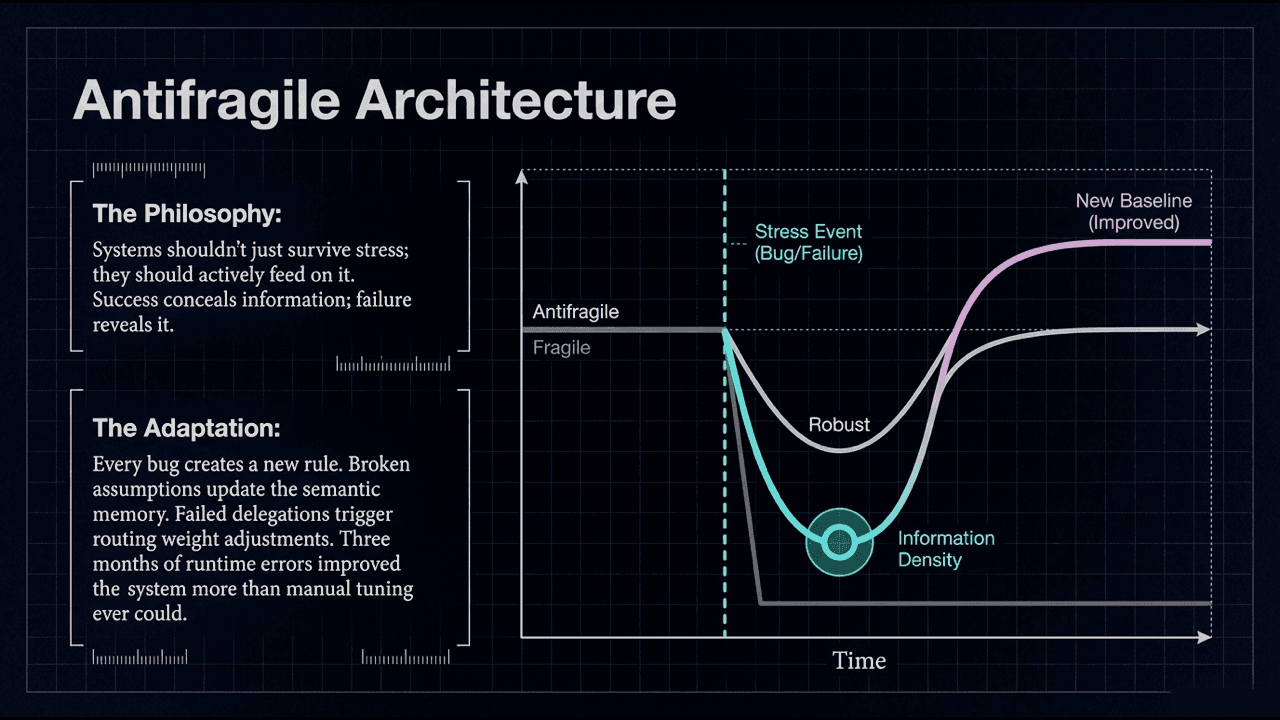
Most systems break under stress. Robust systems survive. Antifragile systems get better.
Every bug my system encounters creates a new rule. Every assumption that breaks gets turned into an updated experience. Every failed delegation adjusts the routing weights. Every drift detection strengthens the monitoring. The system does not just survive errors - it feeds on them.
Three months of errors improved the system more than three months of careful manual tuning ever could. Because errors carry information that success never reveals.
- -System breaks on unexpected errors
- -Manual recovery after every failure
- -Errors are setbacks, not data
- +Errors auto-generate new rules
- +Failed delegations adjust routing weights
- +3 months of bugs improved system more than manual tuning
This lives in primeline-ai/evolving-lite - the self-evolving Claude Code plugin. Free, MIT, no build step.
The Autonomous Cross-Domain Workflow
These five adaptations were not one-off insights. They came from a systematic, autonomous pipeline that runs while I sleep.
Here is what actually happens under the hood:
tmux spawns isolated Claude Code sessions - full autonomous workers with their own context, their own tools, their own 1M token window. One worker runs /auto-run cross-domain, which picks a source domain and starts scouting.
Quantum Lens deconstructs the source domain from seven angles simultaneously. Each lens is a separate agent. The Void Reader asks what is missing. The Scale Shifter checks if the pattern holds at 100x and 0.01x. Anti-convergence rules prevent cheap agreement - disagreement between lenses is where the insights live.
Solution Engine takes those raw perceptions and collapses them into concrete implementation proposals. Not "this is interesting" but "here is the Python script, here is the file to modify, here is the expected before-and-after."
DSV (Decompose-Suspend-Validate), built from cognitive bias research, gates every finding. Is this analogy load-bearing or just cute? Does it actually map to a real problem? What is the weakest assumption? If it survives DSV, it is worth building.
Kairn persists everything across sessions. The finding from Tuesday night is still available on Friday morning. Cross-references build automatically. The knowledge compounds.
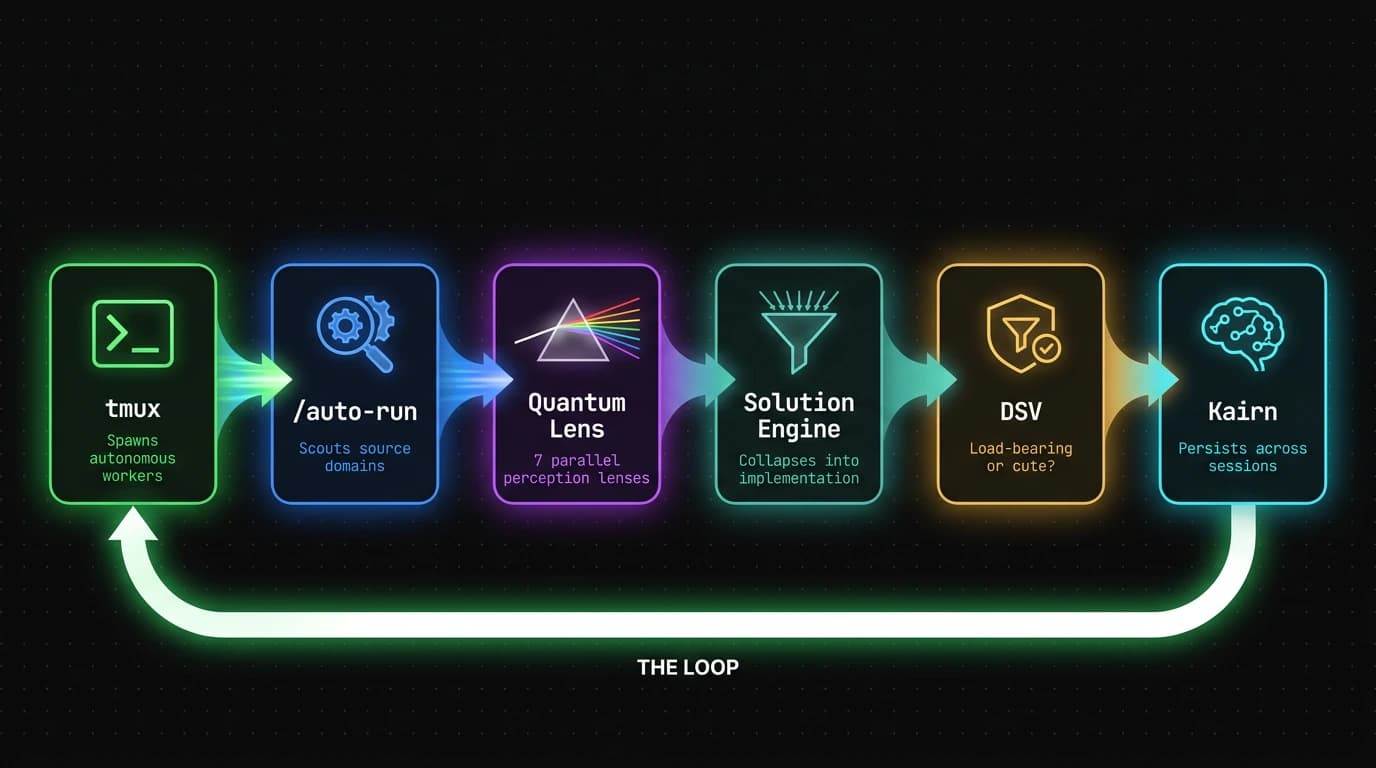
The whole pipeline runs overnight. I wake up to scored findings with source papers, implementation proposals, and effort estimates. The Physarum adaptation scored 9/10 and was found at 3am by an agent I did not supervise.
Twenty-five concepts identified so far. Seven live in production. And the tool that finds new concepts was itself built from one of those concepts.
Open Source
If you want the wider picture first, the anatomy of the whole system shows how these five pieces sit together, and the six failure modes covers what breaks when they do not.
The foundation tools that host these patterns are all open source. Quantum Lens ships the full multi-perspective engine. The other four adaptations (Physarum routing, PageRank ranking, Bayesian updating, antifragile rule generation) live as patterns layered on top of the foundation in my own setup - the code examples in this post are the scaffolding you need to build your own versions on top of Evolving Lite and Kairn:
- Evolving Lite - the foundation system (context router, hooks, rules, agents)
- Quantum Lens - multi-perspective perception engine (full 7-lens implementation)
- Universal Planning Framework + DSV - planning and reasoning validation
- Kairn - semantic memory across sessions
All MIT licensed. All usable standalone or combined.